Thursday, June 7, 2012

"SEA CHANGE" GIVEAWAY

I've said before on this blog that I've carefully cultivated a reputation for absent-mindedness in order to excuse my frequent logistical slip-ups. Brilliant strategy, and I recommend it for readers and writers of all ages.

Guess what? I've done it again.

My dear friend, the lovely Karen White, just released her latest book Sea Change, and in my eagerness to get my desperate paws on the pages, I somehow managed to pre-order TWO copies. And as much as I adore Karen's writing, I really only need one.

But my loss is your gain, my friends! Comment below, and I'll have my youngest daughter pick one of your names from her favorite Hello Kitty bowl on Sunday morning, June 10th. Good luck and happy reading! (And in the meantime, here's a video trailer of Sea Change to whet your appetite.)


Sunday, May 6, 2012

INTO BATTLE


“I adore war. It is like a picnic without the objectlessness of a picnic. I’ve never been so well or so happy. No one grumbles at one for being dirty. I’ve only had my boots off once in the last ten days, and only washed twice.”
       Captain the Hon. Julian Grenfell, writing to his mother, 27 October 1914

Of all the legendary soldier-poets of the First World War, Julian Grenfell is perhaps the most challenging for our postmodern minds to comprehend. He was not a schoolboy fresh out of Eton when he wrote those careless lines; he was twenty-five, an Oxford graduate who had spent the past five years commanding a Royal Dragoons cavalry troop in India and South Africa. Where’s the cynicism, the disillusion, the revulsion? Who in his right mind could compare war to a picnic?

That’s the trouble with history: it’s so easy to project our own modernity into our subjects. We forget that in an era unredeemed by antibiotics and widespread vaccination, death ran rampant through the pattern of one’s ordinary life, accepted and acceptable; we can’t quite grasp that, to men like Julian Grenfell, the onset of war represented a breaking-free from the conventions and hypocrisies of civilized Edwardian society, into the animal purity of battle. Before the muddy stalemate of trench warfare, before the pitiless slaughter of the Somme, war meant escape.

Not that Grenfell was particularly conventional. His true nature lurked behind a thicket of contradictions: he was born the eldest son of a blue-blooded family, but his father’s title was newly-made and the family could scarcely make ends meet. He was tall, good-looking, vigorous; yet he often fell dangerously ill with some inscrutable malady or another, and experienced a profound nervous breakdown near the end of his Oxford career. He swaggered with his parents through the highest social circles, but remained essentially a loner, and a rebellious one at that.

He was funny. Having left home for boarding school at the usual age of ten, he had mastered the art of entertainment-by-letter, and the surviving examples are stuffed with droll little gems. Describing a 1912 regimental visit by the feckless Crown Prince of Germany, Grenfell observes, “We are all quite weary with bowing and scraping… my democratic feelings arouse themselves at 11pm; by 12 I am a socialist and by 1am an anarchist.” Later, narrating a trip to the cinema with a boneheaded companion: “Booth could not understand, the words being by the nature of the performance left for the intelligence of the audience to supply. So I kept up a running commentary: Booth – What are they doing now, eh? Self – Well you see, they are trying to kill him; the cowboys are not sitting on him to try to keep him warm. Booth – Why have they put that rope around his neck, eh what? Self – They are going to hang him with the rope. That is why they have put it round his neck.”

Though he pursued his fair share of girls, aristocratic and otherwise, he had only one full-blown affair, with a ravishing married countess who seems to have seduced him in classic style the year before his departure for India. He doubtless made a frustrating lover in any case, with his restlessness and private sensitivities and his passion for brutal outdoor sports that necessarily excluded women: stalking deer and shooting birds and pigsticking (don’t ask). The modern aversion to killing things would have been incomprehensible to Grenfell. Death was an inescapable part of nature; he loved nature, and never felt closer to it than when he was engaged in its primeval cycle of destruction and rebirth. His most famous poem, Into Battle, captures this sensibility with exquisite precision:

“…And Life is Colour and Warmth and Light
And a striving evermore for these;
And he is dead who will not fight;
And who dies fighting has increase.

The fighting man shall from the sun
Take warmth, and life from the glowing earth;
Speed with the light-foot winds to run,
And with the trees a newer birth;
And when his fighting shall be done,
Great rest, and fullness after dearth…

The kestrel hovering by day,
And the little owls that call by night,
Bid him be swift and keen as they –
As keen of sound, as swift of sight.

The blackbird sings to him ‘Brother, brother,
If this be the last song you shall sing,
Sing well, for you will not sing another;
Brother, sing!’…”

Grenfell wrote those lines on Tuesday, 29 April 1915; on 13 May, near Ypres, he took a shell splinter in the skull while prowling the battlefield for signs of enemy movement. He died two weeks later in a field hospital in Boulogne, surrounded by his family, and was buried in the damp earth overlooking the town. The Times ran his death announcement the next day, along with Into Battle, which duly found itself a quiet corner of the Western literary canon in which to slumber the decades away.

There are no more Julian Grenfells alive today; for good or ill, they have been squashed into extinction under the ironic weight of the twentieth century. It’s now impossible, or nearly so, to be both a man of thought and sentiment and a man of action: a first-rate poet and a first-rate cavalry officer. Grenfell had his faults, but he had keen perception, and thoughtless courage, and the brash humility to revel in the notion of dying for an obscure and ephemeral ideal – the more ephemeral, one suspects, the better. He died a hero, as men of his age were raised to do.

**
 
Note: I am particularly indebted to Nicholas Mosley’s classic 1976 biography Julian Grenfell: His Life and the Times of His Death for its insight into Grenfell’s elusive character.

Tuesday, April 24, 2012

THE LONG WHITE ROAD

If you’ve taken the Eurostar between London and Paris, you’ve seen them: quadrangles of orderly white headstones, dropped apparently at random across the empty fields of Northern France.

They’re not random at all, of course. For much of its length between Paris and Calais, the main high-speed railway line runs along the old Western Front, that network of sodden trenches called home by millions of soldiers for most of the First World War. Nearly a century later, the cemeteries still waypost the front's once-inexorable path southward, from Belgium to the border of Switzerland.

Obsessions do not ask permission before taking over your brain, and the first two decades of the twentieth century – that churning crucible of the modern era – are mine. I can trace the origins of my fascination to a single book: Vera Brittain’s classic war memoir Testament of Youth, which chronicles her journey from the golden sunset of the Edwardian age to the politics and domestic compromise of the threadbare Thirties, when the book was published. Not that I made it that far, at least at first. For me, the book ended with the death of Vera’s fiancé, Roland Leighton, at the end of 1915.

The Great War was famous for that. Military tactics did not catch up with the destructive power of modern weapons until the war’s end, and while millions of ordinary soldiers were slaughtered under the spray of rapid-fire machine guns, the junior officers leading the sacrificial waves faced particularly bleak odds. Memorial tablets at Oxford and Cambridge overflow with their names: gifted scions of England’s finest families, mowed down in their idealistic thousands. (The war’s other belligerent nations, it should be said, fared just as tragically.) Vera was hardly alone in watching her brother, Edward, and nearly all of his schoolfriends meet this fate, one by one; her gift was to bring alive their particular humanity among the millions killed, and no one more vividly than the first.

Roland Leighton was something of a nonpareil, winning six of seven prizes awarded by Uppingham School to its graduating class (Greek Iambics the only miss) and leading the other boys as color-sergeant of the school’s Officers’ Training Corps, a near-mandatory service at the time. As if that weren’t enough, he wooed Vera as much with his feminist principles as his knack for Latin hexameter. He fully supported her efforts to land a place at Oxford’s all-women Somerville College, “if,” as he wrote, “I may be allowed to see something of you on the other side.”

But by then it was August of 1914, and the bell had already tolled for their generation. Roland obtained a lieutenant’s commission in the Worcester Regiment, and Vera enlisted as a nurse at the 1st London General Hospital. Their courtship was carried on mostly by letter: “Good night and much love. I have just been kissing your photograph,” Roland wrote from the trenches in April 1915, to which Vera replied rather pointedly that she “env[ies] the photograph; it is more fortunate than its original.” Roland, ever-gallant, assured her that “[w]hen it is all finished and I am with her again the original shall not envy the photograph… But may it not perhaps be better that such sweet sacrilege should be an anticipation rather than a memory?”

By the autumn of 1915, the tone had changed. Roland wrote that he “feel[s] a barbarian, a wild man of the woods, stiff, narrowed, practical, an incipient martinet perhaps – not at all the kind of person who would be associated with prizes on Speech Day, or poetry, or dilettante classicism. I wonder… if I could ever waste my time on Demosthenes again.”

He would not, in fact. Vera was thrilled to learn that Roland had secured Christmas leave, and went about her duties – decorating the ward, making presents for the convalescents – with heady enthusiasm. The morning after Christmas, she received word that she was wanted on the telephone, and if you ever want to know how to break a reader’s heart in a few matter-of-fact sentences, here’s your primer:

Believing that I was at last to hear the voice for which I had waited for twenty-four hours, I dashed joyously into the corridor. But the message was not from Roland but from [his younger sister] Clare; it was not to say that he had arrived home that morning, but to tell me that he had died of wounds at a Casualty Clearing Station on December 23rd.

So ends Part I, and it was fully years before I was able to pick up the book again and read on.

Vera recovered, eventually. After the armistice in 1918, she went back up to Oxford and finished her degree, going on to become a prominent peace campaigner and woman of letters, with several published novels to her credit. Testament of Youth, however, remains her best-known work; for that alone, we can perhaps understand her implacable opposition to Britain’s role in the Second World War.

I have twice visited Roland Leighton’s grave, which inhabits a crossroads cemetery in the tiny village of Louvencourt in the Somme river valley, overlooked serenely by the Lutyens-designed Stone of Remembrance inscribed Their Name Liveth For Evermore. The place invites contemplation. It’s become proverbial, and a little too pat, to observe that the First World War ushered in the modern age; that a naïve and idealistic generation sacrificed itself for a world in which the word “intercourse” could no longer be said with a straight face. In fact, the years before the war teemed with social upheaval and hellbent scientific advancement, with the clash of traditional and modern: a rich setting for fiction, as any fan of Downton Abbey knows.

And for romance. Tenderness, yearning, conflict, suppressed passion: all these things leap from the pages of Vera’s memoir, and even more boldly in the diary and letters published after her death. (Romantics will be relieved to know that the longed-for snogging did, in fact, take place during Roland’s final leave – and on a moonlit sea-cliff, no less.) This is courtship firmly in the historical tradition, and if my fictional world represents a subconscious attempt to give Roland and Vera the consummation denied them in life, I guess I can live with that.

**


*an image from Roland Leighton’s poem Hédauville, written in the month before his death

Monday, March 12, 2012

A TALE OF THREE COVERS


As any debut author will tell you, the moment you see your first cover is like the moment you glimpse your firstborn child.

So imagine if your newborn were whisked away from the hospital nursery in the dead of night, and you were told, Not to worry! We've got an even BETTER baby in store for you, and a few months later a completely different infant appeared in a basket (or, as the case might be, a FedEx delivery envelope) on your doorstep.

And then it happened again.

Now, it's not unheard-of for a book jacket to undergo changes before publication, as it passes through various hands on its way to the bookseller's New Release table. And to be fair, Overseas defies easy categorization: a sweeping, old-fashioned love story rooted in the First World War, narrated by an utterly modern young woman in twenty-first century Manhattan. Is it historical fiction? Is it contemporary? Is it romance, or simply romantic? In designing a cover, do we focus on the historical aspects of the book, or its modern heroine? Do we market to devotees of historical fiction, or do we throw out our net for a broader readership?

When the first Overseas jacket art came in, I fell in love. The art department had imagined a dreamlike cityscape at sunset (or was it sunrise?), golden clouds merging with aquamarine sky, and then those beautiful words: OVERSEAS, a novel, Beatriz Williams.


It was lovely. It was perfect.

"Can I share it?" I begged my publisher. The answer came back in firm yet gentle tones: not until after the fall sales conference, when the online retailers pick it up. That way, people have something to click and (one hopes) pre-order.

So I waited and waited, and in mid-November Overseas popped up on Amazon with its dreamy cover, and I let loose a torrent of rapturous tweets, Facebook updates, and blog posts. Oh! Ah! sighed my peeps and tweeps, and I basked in that happy delivery-room glow, gestation and labor complete, my baby's precious picture plastered all over the internet for the world to see.

Until the next day, when it disappeared.

I sent an email to my editor, who was on the other side of the world at a book conference. "So, like, the Overseas jacket art seems to have been kidnapped from Amazon. And also from the publisher website. Anything, um, you know, wrong?"

A deathly thirty-six hour silence followed. I waited. I envisioned messages crossing the globe, time zones jostling. At last an email appeared in my inbox.

Good news and bad news, my editor said. The good news is, the sales force loved Overseas. The bad news, they want a new cover.

A new cover? Like what kind of new cover?

Bigger. More...bestseller-y. Special effects.

I had no idea what that meant. Special effects? Does the book blow up in a controlled fireball? Does a holographic image of the my dashing First World War hero reach out from the pages to embrace the reader? But I did like the sound of the word bestseller, so I hunkered down to wait.

And wait.

I tried not to look at pictures of my old cover. I tried not to wonder what the new one would look like. ("The special effects will be...special," my editor assured me, which you know what? Didn't help much.)

Fall turned to winter, the holidays came and went, January stretched out cold and lonely before me. And at last, the FedEx guy parked outside my house and tossed an envelope on the porch with, really, a little too much casual disregard.

I snatched it up, ripped it open, and beheld:


I loved it. The gorgeous sapphire color, the piano die-cut to reveal a bookcase stamped with a glittering nighttime cityscape: it spoke to the novel's contemporary elements, to the music that united the separate worlds of Kate and Julian. It was perfect.

Again I let loose with the social media, again the world sighed with me. Publishers Weekly gave Overseas a starred review and interviewed me for an author Q&A. My baby was beautiful, healthy, happy. I was gurgling with joy.

Until my agent sent me an email with a PS (always beware the PS!): By the way, we have a few tweaks to the jacket art.

A few tweaks?

It's a pretty cover, she said, but I don't think it really captures the book. The new one will arrive tomorrow.

By now, you may have perceived that I'm like any new parent: I love my baby so much, I don't care what it looks like. Whatever the eye color, the nose shape, the degree of ear protrusion, I will just adore the pants off the little mite, because it's mine. So I locked the die-cut piano away in a corner of my heart and prepared to greet the new arrival with joy. After all, how lucky was I to have an agent and a publisher so committed to the book, they'd burn through three designs to get its cover just right?

But when Cover Number Three thumped on my doorstep the next day, inside a box of galleys conveniently printed with Cover Number Two, I gasped.


This was it, I realized. This was Overseas. The glittering city, the mysterious twilit sky, the luminosity. Romantic, enigmatic, depthless. They've nailed it.

I love it. It's perfect.

But, as I said, I'm too partial to judge my own baby. You tell me. Which cover do you like best? Which book would you pick up?

Tuesday, November 15, 2011

COVER ME!

There are many milestones on the road to publishing your first novel: first completed manuscript, contest win, finding an agent, selling your book to your dream publisher. But few thrills compare to seeing the jacket art for the first time.

I've had to keep a lid on this beauty for nearly two months now, but now that Overseas is officially available for pre-order on Amazon, it's time to set my cover free! Behold! (And let me know what you think!)


Monday, November 7, 2011

DARK SECRETS OF THE BOOK FAIR REVEALED!

I don't know how the PTA works in your neighborhood, but in the affluent Connecticut suburb in which I live, the PTA could pretty much crush the Mafia with one well-manicured hand tied behind its back.

Okay, so I had it coming. I'd been lying low for years, while my first three children passed through kindergarten and into the upper grades, hoping I could fly under the radar by volunteering as a room parent and donating stuff when stuff was called for. But last spring, the phone rang in the early afternoon, well before school release, and like an idiot I answered the call.

It was the outgoing PTA president. For reasons still unclear, I'd been nominated for a position on the Nominating Committee. What's the Nominating Committee, you ask? (I did.) The Nominating Committee, my friends, is the committee that nominates people to serve on committees. It's the smoke-filled room of PTA politics, except the smoke has been replaced by the scent of baking cookies in well-appointed kitchens, and the single-malt Scotch by a Dunkin Donuts Box o'Joe (because we are all about keeping things real around here, oh yeah).

So there we are, zapping unsuspecting mommies to chair the thirty-odd PTA committees, like some kind of elite suburban sniper unit, when we came to the Fall Book Fair committee. I'm wiping cookie crumbs from my mouth, wondering if anyone will notice if I snatch a third, when I realize everyone is looking at me. She writes BOOKS, they're thinking. SHE can help organize the book fair. It's PERFECT.

Never mind that I have trouble organizing my own refrigerator. Never mind that, by the same logic, I should organize the Election Day Bake Sale because I happen to make the best goddamned chocolate cupcakes you've ever tasted. It was a done deal. I couldn't even protest.

So I showed up obediently at the school media center (what, you're still calling it a library?) at seven-twenty on a crisp October morning, donned my red Scholastic apron, and started selling books.

One thing became clear right away, as I cruised through the rolling metal shelves and stacked tables: letting a book lover run the book fair is like letting an alcoholic man the liquor store. With a few innocent swipes of my credit card, I became the fair's best customer. In the morning before school, my kids and I would start our stack, and by the time I rang myself out in the afternoon, I could practically hear the entire publishing industry give a distant cheer up the East River and across Long Island Sound.

Another truth: kids love books. Every time another class came in, a high-pitched squealing would fill the air, as if the students expected Justin Bieber himself to be hanging around among the stacks, and not just his autobiography (which he totally wrote himself, haterz!). Sure, many of the girls would head straight for the Pink Table, where we sequestered most of the Barbie and Disney Princess books, and many of the boys bolted for the Pokemon guides. But they were books, real live books with paper pages, and the kids were nuts for them. So, hey.

Third (and this is a big one): if you write books, you should go RIGHT NOW to your nearest bookseller and give him or her a big smacking kiss on the buttocks. I personally sold us out of War Horse and Library Mouse, just because I love the pants off those guys and made sure everyone knew it. It's a big old complicated bookshelf out there, and people want a recommendation. I don't know if it was the red apron or what, but they pretty much bought whatever I told them to buy.

So the week wasn't a loss after all, except for the ten thousand or so words I could have written instead, and it turns out we increased sales 8% over last year, both volume and dollar. (Take that, end-of-the-printed-book chest-beaters!)

The bad news? It looks like I'll be re-nominated to the Fall Book Fair committee next year.

Oh, and I'll see you at at the Election Day Bake Sale table, bright and early.

Tuesday, April 19, 2011

AUTHOR INTERVIEW: CHRISTOPHER FARNSWORTH


When the shock of selling my first novel finally wore off into acceptance, I was intrigued to learn I had a full writer sibling. The previous year, my agent had sold another novel, by debut author Christopher Farnsworth, to my new editor at Putnam. Same agent, same editor: our books must be like twins, right?

Er, no.

But while a taut, pulse-racing vampire thriller like Blood Oath might seem worlds apart from a sweeping love story like Overseas, Chris and I soon figured out we had a lot more in common than our shared publishing connections and an aggressive appetite for bacon. Both of our protagonists are historical misfits, operating in the modern world by paranormal means; both of us find much of our inspiration from examining the past and asking the imaginative what if?. In Chris's case, the answer is Nathaniel Cade, a vampire sworn to protect the President of the United States from supernatural threats, and seriously, what could be more awesome than that?

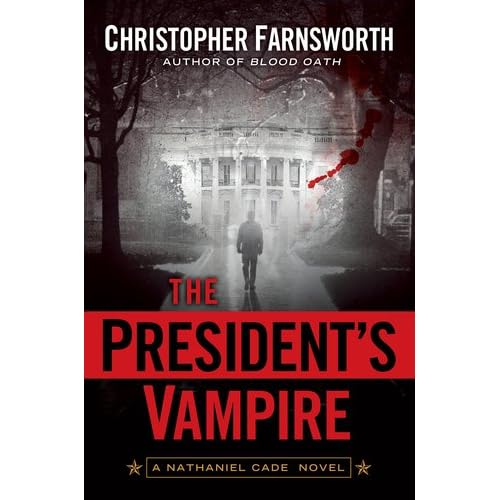
So I loved Blood Oath when it came out last year, and when Chris was kind enough to send me an advance copy of the sequel, The President's Vampire (due out April 28), my squee set off car alarms for blocks around. Once I finished hyperventilating, I begged Chris to let me interview him in my usual hard-hitting Diane Sawyer fashion, and he was gracious enough to indulge me.


Give us a little background on Nathaniel Cade. Where did you get the idea for a presidential vampire, and why doesn't he sparkle in sunlight?

The idea came from a semi-true episode out of American history. According to news reports, in 1867, a sailor was tried and convicted for killing two of his crewmates and drinking their blood. And for some reason, the president at the time, Andrew Johnson, chose to commute his sentence to life imprisonment. The idea stuck with me. I kept thinking, "There's got to be a story behind that. What would the President of the United States do with a vampire?" That's how Cade was born.

Ah, yes, the sparkly question. Cade doesn't sparkle because vampires don't sparkle. Vampires, in my mind, have always been predators. They're meant to eat teenagers, not date them. I'm eternally grateful to Stephenie Meyer for resurrecting the undead once again -- I seriously doubt my book would have been published without the success of Twilight -- but I just don't see vamps as romantic. I stick with the classic Stoker model -- smarter, tougher and meaner than any human.

THE PRESIDENT'S VAMPIRE and its prequel, BLOOD OATH, take all our favorite conspiracy theories and up the ante. Are you a conspiracy believer or a skeptic? Somewhere in between? And what's the nuttiest (or scariest) thing you've uncovered in your research?

I've become more and more of a skeptic. I was a reporter for a long time, and everything I learned about people in that job convinced me that there's no such thing as a successful conspiracy. I once covered a three-person County Commission -- just three people, and they couldn't keep anything secret. If they couldn't stop bickering over low-stakes stuff like zoning ordinances, then it doesn't seem possible to me that the New World Order and the Illuminati would be able to hide the murder of JFK and the presence of aliens on Earth.

That said, I do have a higher tolerance for weirdness than most people. I like to think I'm still open to the possibilities of all the strangeness out there. Lately I've been doing a lot of reading about the idea of a Satanic cabal that is supposed to be the organizing force behind the Manson murders, the Son of Sam, the Zodiac, and a small army of serial killers. There are times when that scares the crap out of me.

But as much as I love delving into all these twisted secret histories, I take them primarily as entertainment.

Of course, I could be in on the cover-up, which would explain why I'd say that.


The confrontation between Cade and Osama bin Laden blew my mind. Any qualms about rewriting history? No fatwa worries?

A friend of mine seriously warned me about including bin Laden in the book. And I'll admit, in light of the whackjobs who threaten people over cartoons of Mohammed, I wondered if maybe I was asking for trouble. Religious zealots seem to have no sense of humor whatsoever.

Then I remembered I write about a vampire who's also a secret agent, and I kept the story the way it was. If a copy reaches Osama in his cave, I may have to reconsider.

In all seriousness, I wrote that chapter before I wrote any other parts of the book simply because it had been festering in me for a long time. I love those old comic-book covers from World War II where you could see Captain America or Superman punching Hitler. Having Cade fight Osama was basically just my attempt to do the same thing.


The relationship between vampire Cade and handler Zach Barrows develops all kinds of layers between BLOOD OATH and THE PRESIDENT'S VAMPIRE. Where do you see the bromance headed? Is it really possible for a vampire to be friends with a human?

That's a good question. I think the answer is uncertain, at least for Zach and Cade. I like to say that Cade, as a vampire, no longer has genuine feelings but instead runs something like a human emulation program. He tries to act like he believes people should act. Again, vampires are predators -- developing feelings for their prey would get in the way of eating. But Cade can still find certain human traits genuinely admirable. He prizes duty and self-sacrifice above almost all else; those times when Zach is tempted to act like a hero -- stupid as it can be -- are the times when Cade sees the qualities he lost when he gave into his need for blood. Zach challenges Cade -- and reminds him what it means to be human.


Dialogue is such a strength in both books -- realistic, witty, plot-advancing -- which must have something to do with your background as a screenwriter. Did you find the transition from scripts to novels challenging? How do you think your screenwriting experience affects your approach to story creation?

I was actually writing books -- unpublished, thank God -- long before I ever wrote a script. I was a frustrated novelist out to make a living, so the actual transition from writing scripts full-time to writing novels full-time has been a joy. Scripts end up being a group activity; everyone has a say in the final product. When I wrote BLOOD OATH, I simply put everything I liked on the page without worrying too much if some studio reader was going to get the jokes.

That said, I learned a lot by writing scripts. A screenplay requires you to cut any line of dialogue that's not carrying its weight, if for no other reason than producers and development execs often refuse to read any block of text longer than a paragraph. I read a lot of David Mamet trying to get that same economy and impact. I tend to block things out in terms of scenes now, and I'm always trying to end each scene on a powerful image, or at least a good exit line.


Vampire bodyguard: pros and cons?

Pros: Works nights. Never wants time off for Christmas. Doesn't demand health insurance. Can travel in baggage compartment.

Cons: Might eat you.

###

Thursday, February 3, 2011

WHY WE LOVE DOWNTON


A friend of mine lamented her addiction to Gossip Girl on Twitter the other day. "It's not so trashy it's good," she wrote. "It's really not. And yet." I advised her to try Downton Abbey instead: so good, I told her, you don't even realize how trashy it is.

Not since Colin Firth stepped out of a lake and into immortality has a British costume drama inspired such stateside obsession as Season One of Downton. So delicious were its plot twists, so iconic were its characters (the Plot-Hatching Footman, the Noble-Hearted Nobleman, the Dashing Eldest Daughter, the Upstart Heir, the Fire-Breathing Dowager), even my husband didn't so much as murmur when I flipped the channel from the NFL playoffs to PBS for an entire January of Sundays. (For the record, we only have one television in the house.)

So why did Downton blow the typical Masterpiece Classic ratings out of the water like a dreadnought at target practice? And did the series really belong in the rarefied air of PBS at all? Take away all those exquisite period details and pretty costumes (and oh! were they ever pretty!) and you've got pure, unashamed potboiler material, complete with dead lovers in the virginal bed and plot-device pregnancies. The show even had the chutzpah to leave its loyal viewers dangling on the brink of Armageddon last Sunday, with the cheerful reassurance that--not to worry--Season Two was now "in production."

But there's more to the Downton obsession than juicy storytelling. After all, if we're only looking for scandal and cleavage, Gossip Girl would do just fine. Downton succeeds not just because it plumbs the depths of the soap-opera well with a long line: it recreates a period that tugs at our historical imaginations with relentless strength. For the Great Britain depicted in Downton and for European civilization in general, there exists--in popular memory, at least--a world before the Great War, and a world after it: an age of innocence followed by an age of cynicism.

Of course, the reality isn't quite so simple. The years before the war roiled with scientific innovation and social turmoil; the crucible of 1914-1918 only forged that raw material into the 20th century we recognize today. But the Downton era beckons us because, until August of 1914, the dead millions and the great country houses still had a chance. It was still high summer, and the garden party was in full swing, and the earl was a good chap, and the housemaid was going to leave domestic service and become a secretary.

Now devotees will have to wait until 2012 to learn the fates of the Crawley family and its dependents. My prediction: at least one war wedding and at least one war baby. And not necessarily in that order.

After all, good trash is hard to find.

Thursday, January 13, 2011

RUN OR DIE


I've never been much of a gym-goer. The first time I worked up the nerve to visit the campus fitness center at college, I spotted the guy I was dating engaged in floor exercises with some sweatless tramp in sleek Spandex hotpants and tumbling blond curls. By tragic coincidence, I had the second act of Madama Butterfly on my Walkman, and as I cycled back through the eucalyptus-scented evening to my dorm, eyes blurred with tears, I longed only for a ceremonial sword on which to impale myself.

After that, I stuck to running.

Sure, it's hard work. The weather rarely cooperates, and I've learned to take gritty joy in pushing myself through heat, drizzle, bitter cold or blowing snow. My schedule is often tight, and I've had to discipline my body to a drumbeat pace, through woods and over hills, to return home in time for preschool dropoffs and birthday cupcake bakeathons.

But when fellow writers ask me how I manage to raise four kids and write novels and keep up my running, I answer that I couldn't do the first two without the third. That time on the pavement is my battery recharger, my idea factory, the forty-five minutes in which my creative blocks fall away and every plot conundrum finds its perfect resolution. I run alone, without a companion or an iPod: it's just me and my brain, getting to know each other again. By the time I've showered and dressed, I've made a crucial new insight into a character's motivation, or mapped out a story arc, or written the next scene in my head.

Which, all things considered, is much more productive than impaling myself on a ceremonial sword.

Saturday, November 20, 2010

BROTHER, SING


The blackbird sings to him, "Brother, brother,
If this be the last song you shall sing,
Sing well, for you may not sing another;
Brother, sing."

Julian Grenfell, Into Battle (1915)


For two weeks now, the Ashokan Farewell has drifted through my mind in random moments. You’ve heard the music: a Scottish lament composed in 1982 by Jay Ungar, it featured throughout the Ken Burns Civil War documentary, a haunting violin capturing the grief of lost manhood more expressively than the words it accompanied.

Until I heard that music in the Great Hall of the British Medical Association building in Tavistock Square, not far from the hospital where I gave birth to two children, the sorrow I felt on the death of Dr. Ian Noble had been largely defined by sympathy for his parents and surviving brother. Joan and Rod Noble had been our first landlords in London and quickly became our dear friends as well. Kinder and more generous hosts could not be imagined. No sooner had the moving van departed than they’d held a cocktail party for us at their gracious Kensington home, inviting young neighborhood couples who in turn became friends of ours throughout our five-year stay in London.

I remember that first cocktail party clearly, because the ring of the doorbell was answered by two handsome ginger-haired boys, aged 12 and 15, whose intelligence and self-possession in adult company astonished both me and my husband. As the years passed, we followed their passages into manhood with delight: the younger and more madcap Jamie went on to the University of Edinburgh and a career in finance, while determined Ian left Eton for the University of Sheffield and became a doctor. In between, we heard noises about boisterous gap years and charity trips abroad. Both boys combined an appetite for adventure with a keen sense of awareness and duty toward those lacking the extraordinary good luck of an affluent London upbringing with loving and supportive parents.

Charmed lives, indeed.

So when I first saw the news – a link posted on my Facebook feed, all very postmodern – my brain couldn’t quite comprehend the information. Doctor, 26, is knocked off scooter and killed a mile from his hospital, the headline ran, and I had to read the article twice to grasp its implications. Ian dead? It was not possible, not conceivable that a young man of such promise, belonging to such magnificent parents, could be killed in the space of a single careless instant by an idiotic motorist on his way to work.

As parents, we all carry that fear, shadowing the backs of our hearts. For all our care and adoration, for all our plans and hard work and agonized decisions, some unknown variable lurks out there in the wide world that can crumble that carefully-built fortress in an instant: a virus, a psychopath, a single mutant cell, a careless motorist. We tell ourselves that the odds are long. We take comfort in statistics. We pray never to hear that phone call in the middle of the night, in the middle of the afternoon; in the middle of a sailing holiday in Croatia, delivered in garbled sentences by a nurse in the very hospital where our son is supposed to be healing the injured instead of succumbing to injury.

That Rod and Joan should have to bear that everlasting burden seemed too unjust to imagine.

At the memorial ceremony at the end of October, I learned enough about Ian’s personality and potential to make my heart break. Stories of terms spent in Nepalese hospitals, of a seat on the British Medical Association board of directors, of rallying friends for impromptu trips to the Lakes, all revealed the passion and enthusiasm I’d only glimpsed in the bright young teenager of our London years. Ian, I realized, was a modern hero, of the sort our society seems rarely to produce any more.

Only then, as the first plaintive strains of the violin wavered in the air, did I really begin to mourn; not just for the agony of Ian’s parents, but for Ian himself, for this reckless and appalling waste of an irreplaceable life. I am not generally given to crying in public, but the tears slipped in long tracks down my face to the sound of the Ashokan Farewell, because Ian was gone and the days that knew his living self were already past.

At the end of the service, when the family filed past, I hardly recognized them. Those faces I had only known with broad welcoming smiles were now shattered, destroyed. Later that evening, I went to visit them at their home, sat on the same green velvet sofa on which I’d laughed and sipped champagne so many times before. Impossibly, they were still the same impeccable hosts. They gave me wine, dinner. Afterward, we walked the familiar steps through the cool autumn twilight to join their surviving son, Jamie, and his and Ian’s many friends at the Churchill Arms. The pub rattled with laughter and energy, with the onward march of young adulthood: a less somber farewell, perhaps, than the one in Tavistock Square, but one that Ian would have approved.
But Day shall clasp him with strong hands,
And Night shall fold him in soft wings.
(ibid.)

Dr. Noble’s family and his partner, Dr Annabel Scott, have established a bursary (scholarship) in his memory to provide financial support to outstanding medical students at the University of Sheffield. To learn more or to make a donation, please visit https://onlinepayments.shef.ac.uk/donations

Thursday, November 11, 2010

AND THERE CAME A GREAT CALM

In the United States, today is Veterans' Day, a day to honor the men and women who serve, or have served, in the nation's military. Across much of the rest of the world, however, the 11th of November will always be Armistice Day: the day the guns fell silent across Europe and the First World War stumbled to its abrupt and Pyrrhic end.

It's impossible for the mind to corral the scale of tragedy enacted during the four years of the Great War. We say "millions died," as if two words could communicate the infinity of loss and sorrow that accompanied each individual death, and then multiply that infinity by millions. Grief needs a human face, a single human story, and Edward Brittain represents no more and no less than any of the young men thrown into the crucible of 1914-1918.

We know a great deal about Edward because he was the beloved brother of Vera Brittain, writer and peace activist, whose Great War memoir Testament of Youth stands as one of the classics of its age. Like Roland Leighton, Vera's brilliant fiancé, Edward obtained a lieutenant's commission in the British army shortly after the outbreak of war, and saw extensive action across the Western Front.

You might think that Edward -- tall, broodingly handsome, sensitive, a talented musician -- wasn't cut out to be an army officer, and perhaps you're right. But he fought on bravely nonetheless: on the catastrophic first day of the Somme, he led his panicked men in the first wave of attack, going back twice to the trenches to urge them over the top. Within ninety yards he'd been shot in the right leg by a machine gun, and followed that up with a shell-splinter going through his left arm. Eventually he crawled his way back to the trenches, recovered from his wounds, and earned a Military Cross for his actions.

Yet for all his battlefield heroics, Edward shines most brightly in the role of brother and friend. He and Vera were exceptionally close, and in the prewar years, as she fought to gain entrance into Oxford and pursue a career of her own, he supported her efforts against the opposition of their Victorian parents. Vera's relationship with Roland Leighton began at Edward's own introduction, and Roland's death -- and those of his other schoolfriends -- hit his sensitive nature with devastating power:

I suppose it is better to have had such splendid friends as those three were rather than not to have had any particular friends at all [he wrote to Vera in June 1917], but yet, now that all are gone it seems that whatever was of value in life has all tumbled down...

We started alone, dear child, and here we are alone again: you find me changed, I expect, more than I find you; that is perhaps the way of Life. But we share a memory which is worth all the rest of the world, and the sun of that memory never sets. And you know that I love you, that I would do anything in the world in my power if you should ask it, and that I am your servant as well as your brother...


In June of 1918, having outlived all the friends of his childhood years, Edward was shot in the head by an Austrian sniper on the Asiago Plateau in the mountains of northern Italy and buried in his blanket in the remote cemetery at Granezza.

After the publication of Testament of Youth in 1933, Vera learned that Edward had, at the time of his death, been facing an official enquiry into allegations of homosexual activity between himself, another officer, and men in their company. Whether the possibility of public exposure led Edward to take risks an officer of his experience should have shunned is almost irrelevant: either way, the end of the war came too late to save him.

This sense of loss and futility still infuses the anniversary of the Armistice. "The war was over," wrote Vera, "but the dead were dead and would never return." Or as Thomas Hardy described it in his poem And There Came A Great Calm:

Calm fell. From Heaven distilled a clemency;
There was peace on earth and silence in the sky;
Some could, some could not, shake off misery:
The Sinister Spirit sneered: "It had to be!"
And again the Spirit of Pity whispered, "Why?"


(Sources: Vera Brittain, Testatment of Youth, 1933; Paul Berry and Mark Bostridge, Vera Brittain: A Life, 1995; Letters from a Lost Generation, ed. Alan Bishop and Mark Bostridge, 1998)

Earlier posts on Roland Leighton and Julian Grenfell can be found here and here.

Tuesday, November 9, 2010

FRANKFURT ROUNDUP!


Missed the Frankfurt Book Fair again? Yeah, so did I. Seems like most of the New York publishing world makes a beeline for Germany every October, and the authors always get left behind, wondering what goes down when 150,000 book people gather together for schnitzel and Jägermeister.

But never fear! This year I plucked the intrepid Liz Parker, foreign scout extraordinaire, away from her groaning post-Frankfurt inbox and sat her down for a few penetrating questions about the Fair, the state of the book market, and just how much lager the publishing industry can consume in a single fevered week.

1) So who are you, Liz Parker, and what's your role in the publishing industry?
I am a scout with Maria B. Campbell Associates, a firm that helps foreign publishers shape their translation lists. In many ways we serve as their eyes and ears in New York (and periodically in other places as well), notifying them of projects on submission and then keeping them apprised of a book’s development. As we aren’t directly involved in the negotiations between foreign publishers and rights holders we’re able to more objectively position a given project. We also serve as the literary representative for Warner Bros. feature and television departments, helping to bring them material to be potentially optioned into a film or series.

2) What's the big deal with the Frankfurt Book Fair? Who goes and why?
The FBF (as locals reference it) is the largest book fair in the world, attracting tens of thousands of people to come and sell, buy or talk books. This year approximately 150,000 industry folks showed up. It’s an opportunity to get your projects seen by editors and publishers outside your everyday circle, and also learn about those books you might have missed when they first went on submission. For the cynic, it’s an absolute chaotic mass of people enduring a week of back-to-back meetings and non-stop social engagements. For the optimist (and those who haven’t attended many fairs), it’s an incredible sight to see a convention center filled to maximum capacity with people who all care about reading.

3) Seriously, though, isn't it all just an excuse for the industry to booze and schmooze on the corporate dime? How much business actually gets done?
It all depends who you are and how well you tolerate said booze… I do think that while a few years ago witnessed more actual book deals being made, now much of the “business” is networking and meeting people in order to extend the circle of contacts. So much of publishing is a social, more personalized business that it’s crucial, especially when you’re starting out, to put yourself out there. And what better social lubricant than German lager at the Frankfurter Hoff?

4) The industry has seen a tough time in the past few years. Any dropoff in attendance and deal flow? How's the mood among attendees?
According to the numbers this year was up from 2009, and the overall mood definitely seemed heightened. While the face of books is certainly changing, the wave of digital attention is sending the message that publishing isn’t dying. It’s simply evolving into a different sort of muscle. A lot of the fair paid due to e-books, royalties and digital marketing – three things extremely relevant to editor, agent and author alike.

5) What's the big buzz this year? Any exciting projects getting talked up?
It was interesting that a YA/Crossover novel swept up a lot of the early-fair buzz as that genre has been the talk of the industry for the past year. There weren’t any major surprises submission-wise, but it was exciting to see that everyone (publishers and agents) had something to show. But I must say that a lot of attention was paid to all-things digital. I think people are starting to think more in terms of a book’s entire package – not just the book’s actual content, but if it could thrive in another format (film, television, enhanced e-book) or grow into a series. This all goes back to how the current climate is forcing publishers to flex their creative muscle in order to remain indispensable. I don’t see publishers becoming dispensable anytime soon, but I do notice everyone is actively trying to think outside the box. All in all, the fair was upbeat and cheerful, and I think offered an encouraging message that books aren’t going anywhere.

So there you have it! Big thanks to the fabulous Liz for the rundown. (Next year, the apfel streudel's on us.)

Monday, October 25, 2010

BEHIND EVERY CHAMPION HORSE...


Yesterday I took my daughter to see the movie Secretariat for the second time. In fact, if I'd had my way, it would have been National Take Your Daughter to See Secretariat Day.

For those of you who missed the movie (and there are a few of you), or those of you who don't know the Triple Crown from a triple bypass (almost as many), Secretariat was American horse racing's golden boy. A big, gorgeous chestnut to make young girls swoon, he completed his 1973 Triple Crown sweep with a record-setting 31-length victory in the Belmont Stakes that, in my opinion, stands as one of the single greatest athletic achievements of all time, human or equine. As a tween, I had a crush on Secretariat so geeky and all-consuming, only a juggernaut force like puberty could break it.

So yeah, I was looking forward to introducing my eight-year-old daughter to Big Red. But I didn't realize I'd be treating her to an even rarer sight: a genuine cinematic heroine, driving the action not by sexual conquest or adorable ditziness or blood-and-guts ass-kickery, but with dignity, perseverance, humor, and the courage of conviction. And even a couple of crow's feet.

Not that I'd forgotten the story of Secretariat's owner, played here with steely charm by Diane Lane. Penny Tweedy's famous coin flip with Ogden Phipps, giving her ownership of the then-unborn champion, is the stuff of Thoroughbred legend. But it never occurred to me what a struggle it must have been, balancing the needs of her family (like me, she had four children) back home in Colorado with the thrill and challenge of developing her promising young colt into a superhorse, all the while facing possible bankruptcy from the taxes on her father's estate. That she juggled all this amid the condescending sneers of the testosterone-laden 1973 horse world (the Jockey Club only began admitting women in 1983, and Penny herself was one of the three who joined that year) gives her achievements even greater luster.

Women complain loudly and justly about the dearth of meaty, multi-dimensional female characters coming out of Hollywood. (Sorry, folks, but after Sex and the City 2, Carrie Bradshaw no longer qualifies.) If you're one of them, stop reading now and stagger off to your local cineplex as fast as your stilettos can carry you, before the big red horse and his heroic owner find themselves replaced by Saw 3D.

Better yet, borrow your nearest 8-year-old girl and bring her along with you.

Thursday, September 30, 2010

A TALE OF TWO CONTEST ENTRIES


I heard the other day that only one manuscript in ten thousand gets picked up by a publisher and turned into a book. That's a whole lot of doomed aspiration (and, alas, a whole lot of crappy manuscripts), and it got me thinking: what sets the winning effort apart from the 9,999 also-rans?

As it happened, I had just finished up judging my share of a writing contest, and the answer lay right before me.

Entry 1 was neat and tidy and grammatically correct (more or less). Set in a familiar time period, it featured a cynical alpha hero and a feisty young heroine. They squabble, they bicker, they play petty tricks on each other, all in an attempt to disguise Their True Feelings. All the appropriate mechanics are in place: the laws of point-of-view are obeyed with religious fervor, the five senses are celebrated with due consideration, the backstory emerges in well-judged snippets of dialogue. I really, really wanted to like Entry 1.

There was just one problem. It was boring.

Entry 2, on the other hand, was a mess. It dared to take place in a wholly unapproved time and place, and mentioned icky things like God. The hero and heroine hailed from non-European cultures. Grammar and punctuation took a romp on the wild side. The author once -- oh, the horror -- switched her point-of-view character IN THE MIDDLE OF A SCENE!

I loved it.

So what gives? What made me scribble enthusiastic comments all over the last page of Entry 2, and bite my metaphorical pencil with the effort of bucking up Entry 1? What makes a good read a good read?

For the purposes of a digestible blog post, I'll narrow it down to two things: voice and conflict.

1) Voice. While Entry 1 read smoothly, with serviceable prose and suspenseful scene-endings, it just felt...flat. No wit, no zing, no originality. The usual phrases evoked the usual emotions. I'd read this story a thousand times before, and this one had nothing new to say, as if the author's personality had been smothered under the collective weight of a thousand well-meaning critique groups.

Entry 2, on the other hand, vibrated with energy and humor and wisdom, and breathed genuine life into what might have been a generic character pairing. The author's love for the period and culture burst through all those awkward sentence structures and grammatical miscues, and her use of image and metaphor was occasionally brilliant. Could the manuscript have used another pair of eyes, preferably ones attached to an English major's brain? Sure. But that's not what I mean by voice.

2) Conflict. Entry 1 takes place in a time of war and opens with a fight scene, so you'd think the story would rattle with conflict. You'd be wrong. Good romance feasts on the meat of the forces keeping our couple apart, and in this story, every possible external factor ENCOURAGES them to unite. So why don't they leap straight before the altar and into bed? Oh, blah blah need to be true to myself blah. You know, stuff that plagues the minds of pre-Enlightenment couples during the throes of war. I'm being a little harsh, of course, in order to make a point: Nothing's at stake. These two are just going to keep on bickering for a few hundred pages, denying Their True Feelings and junk, and then get married. A writer with a really brilliant voice could make this interesting, but...see #1 above.

The author of Entry 2, on the other hand, puts all kinds of barriers between her protagonists. They're from different cultures, different classes, different regions. Their goals lie far apart. In order to come together, one or both of them will have to give up everything. Who will it be? How will it come about? I want to know.

Now, I'm not saying that Entry 2 is ready to be shelved in your local bookstore. But if I had to lay my money on one of these two manuscripts to beat the ten-thousand-to-one odds of publication, I'd pick the second.

At least, that's the one I'm rooting for.

Monday, September 13, 2010

MORE SEX, PLEASE: WE'RE BRITISH FOOTBALLERS

Whenever my vulgar curiosity needs satisfaction, I turn to the Daily Mail website. What, you've never visited? The DM's intrepid squad of reporters fans out across the globe, leaving no Dumpster unsifted in the quest for sordid celebrity gossip (or, as the DM delicately names it, Femail), so readers are kept up-to-the-minute on which celebrities are too skinny (Angelina!) and which are too fat (Jessica!) and which have just been outed for cavorting with prostitutes while their wives were pregnant.

The latest in that illustrious line would be 24-year-old footballer Wayne Rooney, a star player for Manchester United and the England national team, whose response to the scandal is that he's "not prepared to take any s--- off the wife and her family" and "if she can't handle it and it's over, so be it." If this sounds a bit jaded, well, Rooney's been there before: he's already well-known among football fans and Femail readers alike for his teenage encounter with a 48-year-old hooker known (affectionately, one presumes) as the Auld Slapper.

At least wronged wife Coleen can take comfort in the fact that she's not alone. From Elin Nordegren to Sandra Bullock to Silda Spitzer, the wives of high-profile men have put up with a lot of high-priced competition over recent years. Or maybe the cheating was always going on, and today's offenders are just unlucky to have come of age in a time of instant news and transparent privacy. The Rooney affair came to light when Juicy Jeni -- one of the ladies involved -- sold her story to a tabloid, prompting a wave of disapproving website commentary that she was dishonoring her profession.

Whether it's the reap-the-rewards mentality of successful people, or our modern capability for rationalizing and entitlement, or the diminishing sacredness of sex in Western society, we've heard any number of reasons for the infidelity epidemic. Rooney's petulant comments suggest that he knows he did a bad thing, but can't summon the moral fiber to blame himself for it. As an athlete, he ought to be well-acquainted with self-control and physical discipline; apparently, though, he chooses to save all that effort for the football pitch, where it's appreciated by legions of worshipful fans rather than a single nagging wife in the yucky throes of pregnancy.

Anyhoo. The Daily Mail will feast on the story for a week or two, and then the Rooneys will probably reconcile and have another baby, and Femail will move on to obsess over the speed at which Coleen loses her pregnancy weight.

Which means the next celebrity cheating scandal can't be far behind.

Tuesday, September 7, 2010

GOOD FOR THE GANDER?


With the Franzen vs. Ladywriters dispute in full kerfuffle last week, I thought I'd better start reading me some Jennifer Weiner over Labor Day weekend. (I'm saving Freedom for the kind of late-autumn evening in which the yowls of sociopathic songbird-eating cats drown out the sound of acid rain beating against the roof of the nearest corrupt Halliburtonesque corporation.) So this post was meant to be a serious examination of women's fiction and its place in the modern literary landscape.

Alas, my feeble ladywriter brain is easily distracted by trivialities, and instead I found myself thinking about fat.

Cannie, the brilliantly-portrayed heroine of Good in Bed -- I began with the earliest of the Weiner oeuvre -- spends much of the novel battling the demons of body image on the way to her happy ending, and reminded me in many ways of Min, the heroine of Jennifer Crusie's more comic-toned but still weight-obsessed Bet Me, which I'd also read recently. In fact, I've come across a lot of books featuring curvier women in the past several years, all of which celebrated the beauty of ample endowment and the men who appreciate a well-rounded figure.

I couldn't be happier. I love reading about women of all body types, from dainty to athletic to lush, and it's about time that fiction recognized the beauty of diversity. A woman is loveliest when she's in tune with her natural shape, and both Weiner and Crusie tell this truth with aching eloquence.

But what about the dudes?

In each of these books, and others playing the same theme, the heroine ends up with a man of about one-percent body fat. He doesn't always have a pretty face, and he may not be muscle-bound, and he may measure in a shade shorter than the requisite six-two, but by God he hasn't got an extra ounce of padding on him.

Now it's great that our curvy women end up with what American society considers attractive men, but just how far are we pushing back the fat-is-ugly stereotype if it still applies to guys? Why, Cannie herself dismisses one man as "paunchy," and every fellow she's attracted to happens to be stick-skinny. What gives?

Biology might answer back that softness is womanly, and hardness is manly. Fine, but aren't we supposed to be beyond biological stereotypes? Or maybe a publisher would argue that these books are all supposed to be fantasy anyway, and novels without mantitty wouldn't sell. But doesn't that just misjudge so-called women's fiction, and women in general?

What do you think? Have you come across a novel with a less-than-lean but still-desirable hero? Would you like to see a guy with a love handle or two?

(And as for that serious post about Franzen and Weiner and literary vs. commercial fiction, I might as well forget it, because Ron Hogan has a much better version over at Beatrice.com.)

Tuesday, August 31, 2010

HOW I SURVIVED MY SUMMER VACATION


We have this glorious first-day-of-school tradition at our house, in which we scorn the big yellow bus and trudge uphill en famille through the late-August heat to arrive sweaty and exhausted at the schoolhouse door. (It's delightful, really; you should try it sometime.) This year our third child donned the ceremonial kindergarten backpack and joined his older siblings, and as my husband and I walked back out into the heavy sunshine, pushing the stroller that contained our last remaining toddler, a part of me wanted to howl in sorrow at the passing of summer and playtime and youth itself.

The other part wanted to bolt down the sidewalk shouting, "FREEDOM!"

Don't get me wrong. I love my kids. My husband and I both work from home, raising them without a nanny or part-time babysitter. I'm a hands-on, roll-around-on-the-floor, tuck-'em-into-bed kind of mom, and I wouldn't have it any other way. And that's the problem.

Come summer, I can't get any work done.

Now, I know it's a problem I share with millions of other moms. And I'm luckier than most: not only is novel-writing an extraordinarily fulfilling career, it also fits neatly into the nooks and crannies of suburban motherhood. While folding my way through a Himalayan mountain of laundry with my Sherpa guide, I can imagine an entire character arc into vivid detail. Racing past yellow stoplights in the Sticky Minivan to deliver my nine-year-old to soccer practice, I can solve the most intractable plot conundrum at very little risk to other drivers.

But the whole system depends on having a few hours a day to myself, in which to imprint all these magnificent thoughts onto something more permanent than my overloaded short-term memory. And when my day is filled with feeding, cleaning and adjudicating my own marauding band of restless youngsters, plus a couple of stray neighbor kids wandering by at lunchtime, the only imprinting around here occurs when I bang my head repeatedly against the kitchen counter. (It's just so soothing.)

And yet somewhere in the middle of all that sand and salt water and ice cream and sidewalk chalk, we managed to have a pretty good summer. Our five-year-old learned to ride his bike without training wheels. Our nine-year-old finished the Percy Jackson series, and his seven-year-old sister climbed Mt. Washington by his side in her ruffled pink hiking shorts. The baby turned two and started demanding her own Happy Meal box at McDonalds. I wouldn't have missed a single milestone, even when it marked one more step in the journey away from the nest.

Now the big kids are in their classrooms, and the baby's napping, and I'm sitting in front of the computer at last, being myself. And you know what? I can't wait for my gang to come home and toss their backpacks over the clean floor and tell me all about the first day of school.

As long as they go to bed early.

Sunday, August 15, 2010

KING OF THE MOUNTAIN

My husband made several attempts to kill me while we were dating. First, he dunked me in the Connecticut River, during the course of an early-April canoe ride against both tide and current. Next, he took me home to meet his mother, who made me a pot of soup thick with wild mushrooms, which everyone knows are poisonous.

Then there was Mt. Moosilauke.

It's just a quick forty-five minute hike to the summit, he assured me. A mere stretching of the old joints. No need to weigh ourselves down with unnecessary items like windbreakers. Or lunch. Or water.

Turns out, that forty-five minutes represents the record time posted by the Dartmouth ski team in its annual race to the top. For those of us hiking without the benefit of months of intense aerobic conditioning, it's more like three hours. Each way. By the time we scaled the final monstrous New Hampshire boulder, wind flattening the alpine vegetation, my tongue was furry with thirst. By the time we staggered back into the lodge, my so-called boyfriend's trachea remained intact only because I was too weak to lift my hands.

So when my husband proposed taking the family up Mt. Moosilauke for a bit of a summer jaunt, I resisted. After all, this was the same man who once cheerfully suggested I slake my thirst in a mountain stream clogged with Giardia. But eventually his persistence wore me down, and I agreed with two conditions: one, we update our wills before the attempt; and two, we carry enough water to float a minor navy.

About a mile into the hike, I regretted my cave-in. Our five-year-old, after an enthusiastic start, sat himself down on a rock and refused to continue. My back was aching from a night spent on the plastic slab of mattress provided by the lodge bunkhouse. Plus, all that water was getting kind of heavy.

And then I looked over at my husband. Spine still unbowed, despite last night's granite mattress and the twenty-four-pound toddler strapped to his back, he took our five-year-old's hand and coaxed him onward with a bribe of yogurt-covered raisins. Our other two kids followed along in agile leaps, already veterans of New Hampshire hiking trips with Daddy.

So I took a drink of water and trudged up the trail behind them, watching out for little stumbling feet and smiling with pride when the older two, playing a game of "favorite things" to pass the time, never once mentioned TV.

Two hours later, I stood on the wind-whipped summit and watched my nine-year-old son point out the peaks he'd climbed with Daddy in previous summers. They reared up around us in acute angles and forested slopes, the weather shifting uneasily about the crests. I put on my windbreaker and sat down to eat my lunch, and though it took the unprecedented lure of a full can of Sprite, all to himself, to drag our five-year-old all 3.6 miles back down the mountain, I wouldn't have traded a moment.

Even if it killed me.

Monday, August 2, 2010

THE AMAZING SISTERHOOD

A few years ago, just after I woke up in the cold sweat of my early thirties and realized I'd better get serious about writing, I had lunch with an acquaintance of mine who works as an editor at a well-known science fiction publisher. I told her about my writing plans -- historical fiction with romantic elements -- and she immediately suggested I join the Romance Writers of America.

I cast my mind back to the romances I'd devoured in high school and college. All fun and games, I thought, until you have to write the words 'turgid manhood' with a straight face. "Well," I said doubtfully, "I'm not sure if romance is my thing."

She shook her head. "RWA has a big tent. If you've got a love story, you're in. And the resources are huge. Workshops, conferences, contests. There's no better way to plug into the publishing network."

At that point, I wasn't in any position to be ignoring advice, and a few months later I walked into the hotel lobby at the RWA National Conference in Dallas. I didn't know a single soul, and until I opened the freebie paperbacks in my registration totebag, I hadn't read a romance in 15 years. Worse, the women around me were gathering into cliques, squeeing with delight, gossiping and texting each other. High school flashbacks began to explode in my brain. My right foot poised in midair, ready to flee for the elevator and lock myself back in my hotel room.

Luckily, I didn't. I stayed, attended workshops, ate chicken lunches in cavernous ballrooms. I gathered courage and introduced myself. I saw brilliant and accomplished women like Eloisa James and Lisa Kleypas lead sessions and give speeches. I saw a soaring variety of books being promoted, from classic category romance to hardcover historical fiction. I thought, maybe I do belong here. Maybe I can join a clique. Maybe I can even start a clique.

By the end of the conference, I was inspired. I'd read a few of the books in my totebag and discovered that romance had come a long way from the early 1990s, and I'd met a few of those texting women and found them full of welcome and enthusiasm for newcomers. I came home with notebooks full of storytelling techniques, and -- though I didn't realize it at the time -- the germ of an idea that became my first novel, OVERSEAS.

More importantly, I'd found a community. Whatever these women (and a few dudes too, it must be said) are writing, from sweet Amish love stories to kick-ass urban fantasy, they encourage each other through every step of the road through publication. They cross-promote with blogs and Twitter, they whoop and cheer and share information over email loops, they critique each other constructively through local chapters and contests. This is RWA's finest legacy: the unflagging and democratic support for all our fellow writers, published and unpublished.

I don't know if I'll ever manage to produce a true genre romance novel, but I'll always be a proud member of RWA and a devoted fan of its fabulous authors.

None of whom, by the way, would ever write the phrase 'turgid manhood.'

Wednesday, July 21, 2010

COUSIN BUNNY


A stack of my grandfather's typewritten memoirs sits in a cubby next to my computer, ready to be picked up and idled through whenever procrastination strikes. I discovered Bunny Chantrill during such a moment.

I flashed off an email to my father (we Chantrills are an email clan, rather than a phone clan): "Dad! Did you know your father had a cousin named Bunny who played Rugby for England in the 1920s?"

He'd heard.

"Well, why didn't you tell me?"

I already knew the answer to that question. Chantrills beat their chests about famous ancestors as often as they pick up the telephone, which is almost never. It's not surprising that poor old Bunny is dispatched with a short paragraph in "I Remember: Volume I":
One of Sylvia's brothers, Bevan Stanislaw, b. 11 February 1897, was named for [my grandfather's] father and also called Stasho by the family, he played Rugby for England. He was known as Bunny, and this later proved an embarrassment for [my grandfather] when he played Rugby for the Wasps, as everyone expected him to be another Bunny Chantrill. When last heard of, Bunny was in South Africa.
With my grandfather's memory so little forthcoming, I turned to Google, and holy crap it turns out Bunny was a legend. According to the Bristol Rugby website:
"Bunny" Chantrill was one of the most capable full backs to have donned a Bristol jersey. A small but immensely powerful man, he relished the physical side of the game. Tackling was his forte, and countless attacking players were "Chantrilled", as the local press described his powerful tackling... After a couple of seasons during which Chantrill terrorised sundry attackers he was selected for England. He played for all four matches in the 1924 championship in which England won the Grand Slam. He had an exceptional game against Scotland, a hugely talented side, and it was only through his courage and appetite for the tackle that England won.
As I dug deeper, I discovered that Bunny's Rugby-playing career had been interrupted by the First World War, in which he'd served as a second lieutenant in the Queen's Own Hussars, Gloucestershire Regiment, before joining the Royal Flying Corps in early 1918, the final year of the war. About his war record itself I found little, but if he survived four years as a junior officer on the Western Front, he must have been either wildly lucky on the battlefield, or wildly lucky in his postings. From our postmodern vantage, it's easy to speculate that his fearless tackling on the playing field might have reflected the psychological impact of the war. Unless, of course, it's the other way around: that he survived the war, physically and mentally, because of his ability to attack without fear. "I love tackling more than anything else in rugby," he's reported to have said. "What a glorious feeling it is."

By 1929, age and injury had put an end to Bunny's Rugby career, and he left England to mine for gold in South Africa. He stayed there until his death in 1988, serving in the South Africa Air Force in the Second World War and outliving two wives.

There are several Rugby and World War I websites with pages devoted to Bunny Chantrill, many of them stuffed with grainy images of my broad-shouldered cousin, standing cross-armed in a blood-spattered jersey or flying toward his opponent on a cigarette card. My favorite has him shaking hands with King George before the Scotland match in 1924, a white plaster flashing above his right eye. He has a distinctive strong-featured face, so you can pick him out easily without looking at the captions.

But for all that biography out there on the internet, the public remains unaware of the most salacious detail of all, one that would have ROCKED middle-class interwar Britain to its CORE! Yes, folks, listen up! For two paragraphs above Bunny's notation in "I Remember: Volume I", my grandfather reveals the following:
[Bunny's mother's father] Northam had kept two separate establishments: one, the legitimate one, in Bristol, and a second one in Kidderminster, where he was frequently absent on business. Neither wife knew of the other until Northam died and his will was read, distributing his estate between his two families. [Bunny's] mother inherited the great house in Bristol.
Nothing more is said about the scandal, my grandfather being a Chantrill. But damn my eyes if it doesn't have the makings of a juicy novel.